MetriCup Guide
How to Staff Your Coffee Shop Smarter: Weather, Holidays, and the Data Behind the Schedule
 Rich Manalang
Most coffee shop schedules copy last week's schedule, adjusted by gut feel. Here is how a data-driven approach works across different store locations.
The problem with scheduling from habit
Most scheduling decisions follow a routine: copy last week, add a barista on Saturday, pull someone off Monday, and publish. It is fast, but it compounds scheduling mistakes. If last Wednesday was overstaffed, this Wednesday will be too. It ignores upcoming weather shifts, holidays, and neighborhood events.
Most demand variability follows predictable patterns when you connect the right data inputs.
Start with the baseline: normal day demand
First determine what a store typically sells on a specific day of the week. Calculate the median net sales of the last four non-holiday matching weekdays.
The median works better than the average. If one Tuesday included an unusual $800 catering order, the average skews high and creates an inflated staffing target. The median ignores that single outlier.
Once you establish your baseline, you know what a standard shift costs in labor hours. Everything else adjusts from that starting number.
Holidays affect each location differently
When a federal holiday approaches, many operators cut hours across the board or treat it like a regular day. But the same holiday produces opposite effects depending on store location.
An office-district cafe on Presidents Day can lose 80% of sales because surrounding offices close. A residential neighborhood cafe on the same day can see a 30% increase because neighbors stay home and walk over for morning coffee.
Applying a blanket holiday policy across all locations leaves one store overstaffed and the other overwhelmed. Calculate holiday adjustment factors per location, using each store's historical numbers on that specific date.
Example
Office-district cafe, Presidents Day: −81% vs normal Monday
Residential cafe, Presidents Day: +34% vs normal Monday
Same holiday. Same city. Opposite staffing needs.
Weather sensitivity is measurable
Rain affects coffee shops differently. A walk-up kiosk with outdoor seating can see a 25% drop in sales on a rainy morning. An indoor cafe with a drive-thru or covered parking might barely notice.
Measure rainy day sales against same-day-of-week medians over the past year to calculate each location's weather sensitivity factor. Repeat this for cold snaps, heat waves, and clear weekends.
With calibrated weather factors, your 14-day weather forecast becomes a direct input for scheduled hours.
The three-layer forecasting model
Effective coffee forecasting combines three sequential inputs:
- Baseline: Median of the last four same-day-of-week sales, excluding holidays.
- Holiday factor: Per-location multiplier based on historical performance on that holiday.
- Weather factor: Per-location sensitivity multiplier applied to forecasted conditions.
Multiply these layers to calculate predicted revenue. Then divide by your target SPLH to generate recommended shift hours.
Formula
Predicted Sales = Baseline × Holiday Factor × Weather Factor
Recommended Hours = Predicted Sales ÷ Target SPLH
Where manager judgment steps in
A forecast provides a baseline. It will not know about sudden street closures, equipment repairs, or local school sports tournaments. When unforeseen events happen, the model will miss, and that is expected.
Use the forecast to give store managers a calibrated starting point, then let them make final adjustments based on neighborhood knowledge.
MetriCup
14-day forecasts built into your dashboard
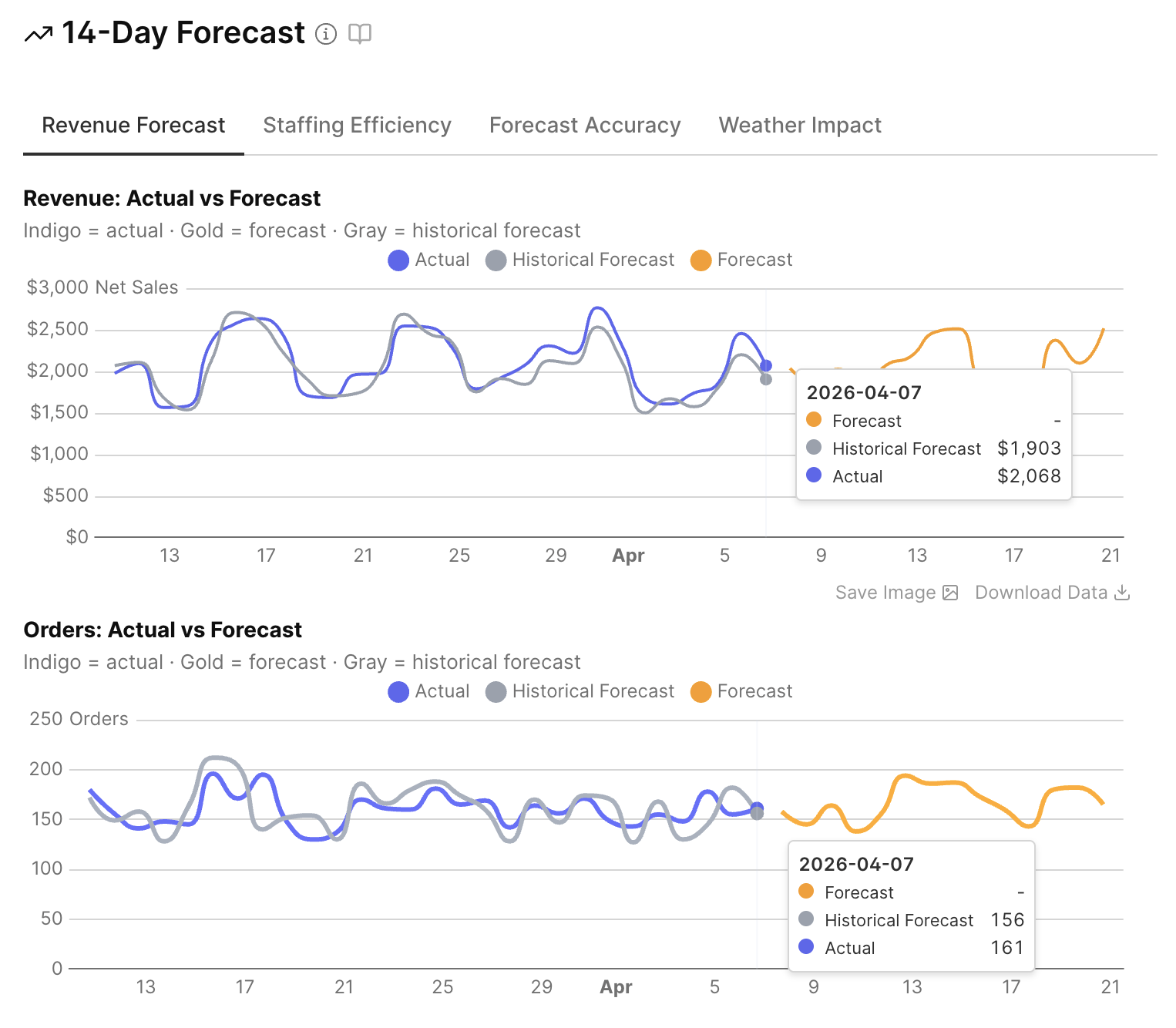
MetriCup calculates per-location forecasts using your historical POS data, per-store holiday multipliers, and weather conditions, placing recommended staffing hours directly in the schedule table.
Get early accessRelated Operator Guides
View All Guides →The Multi-Channel Margin Trap: When Delivery Apps Cannibalize Barista Tips
Delivery apps take a 25% commission rake and average 0.4% tips compared to 12.4% in-store.
Why Your Store Managers Never Look at BI Dashboards (and Why 6:00 AM Email Briefs Work)
Automated 6:00 AM email digests give opening shift leads actionable numbers before doors unlock.